

The rise of Floridians pushing for more conservation has been incredible to observe. We are tired of clear cut land, expanding development past future development boundary lines, and putting our ecosystems at risk. Conservation has become a buzz word in Tallahassee that needs to become even more of an action word. Currently, 31% of the State of Florida is currently conserved, but the real question is, is that enough?

The Office of Economic and Demographic Research (EDR) recently completed the ninth annual assessment of Florida’s conservation lands pursuant to section 403.928, Florida Statutes. This office evaluates public and privately owned land that acquires a conservation status. According to the study, Florida expended $266.84 million on conservation land acquisition and $280.1 million on conservation land management in 2023-2024. More land in conservation means more money into managing that land properly, a cost that is well spent in order to preserve Florida’s unique ecosystem.
The state’s goal is to raise the conservation percentage from 31% to 41%. Unfortunately, this comes with a cost. A cost that will outlive both you, me, your kids, actually about 6-7 generations. “In total, the analysis identifies a best working number of 3.32 million acres for acquisition at a cost of approximately $33.5 billion or just over $10 thousand per acre. The analysis suggests that roughly 85 percent of this cost would be the state’s responsibility. At the average rate of annual state conservation land acquisition expenditures over the most recent five fiscal years, it would take approximately 200 years to produce the state’s share.” TWO HUNDRED YEARS to financially cover the cost. We don’t have two hundred years. I’m not sure we even have 25 years at the rate development is expanding. So how did we get here?

Before the 1960s Florida didn’t have any type of land conservation program. There wasn’t any concern of population, density, or any real development, it was mainly agriculture operations. At that point even Disney World wasn’t created, so the concern was minimal. Sadly, through the decades this assumption may have held true. Agriculturalists are known as the best stewards of the land, but as we know, some of the farmland we once knew as kids is now farming rooftops and St. Augustine Grass. Between 1960 and 2020, Florida’s population more than quadrupled. Although Florida has created numerous conservation programs such as 1970s-Environmentally Endangered Lands (EEL) program, 1980s-Save Our Rivers program, 1980s- Save Our Coast program, 1990s- The Preservation 2000 program, 1999- Florida Forever program, it appears that the programs are falling behind the drastic population increase.
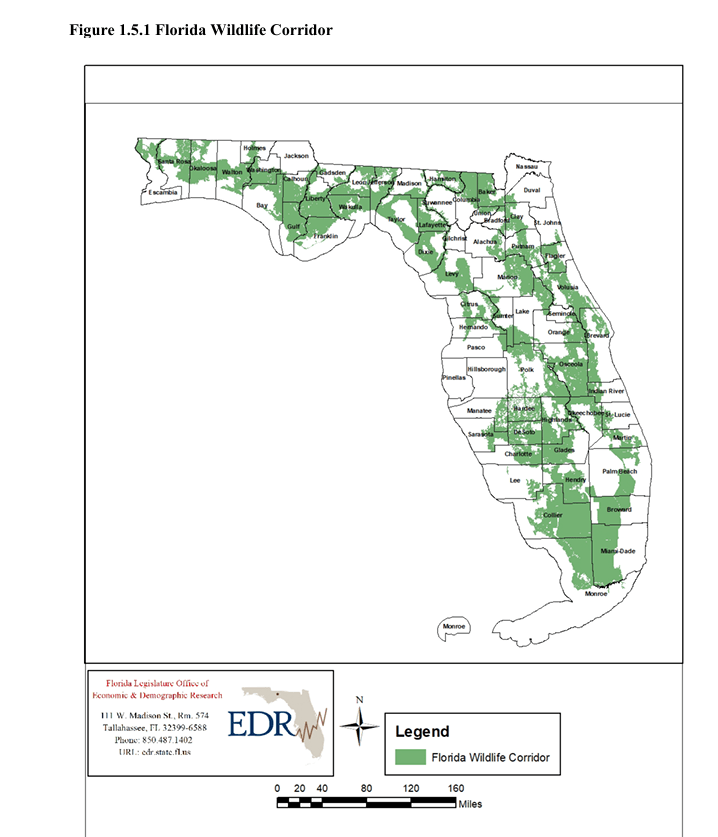
The Florida Wildlife Corridor Act in 2021 began to direct DEP to invest in areas that protect and enhance the Florida Wildlife Corridor. It put the Wildlife Corridor geographically on the map with 18 million acres, of which 10 million acres are protected conservation lands. Increase in human development, many habitats have been lost, more roads are created, more commercial businesses, which mean less land that connects habitat areas potentially creating fragmented islands. The Florida Wildlife Corridor is working hard to bridge the gap and allow animals to travel throughout the state while avoiding roads and other developments. There are 1.46 million acres within the Florida Wildlife Corridor opportunity area that are a high priority for conservation through the state’s Florida Forever program. It’s going to take county governments and the state to work cooperatively to help purchase more lands to maintain healthy animal and plant populations
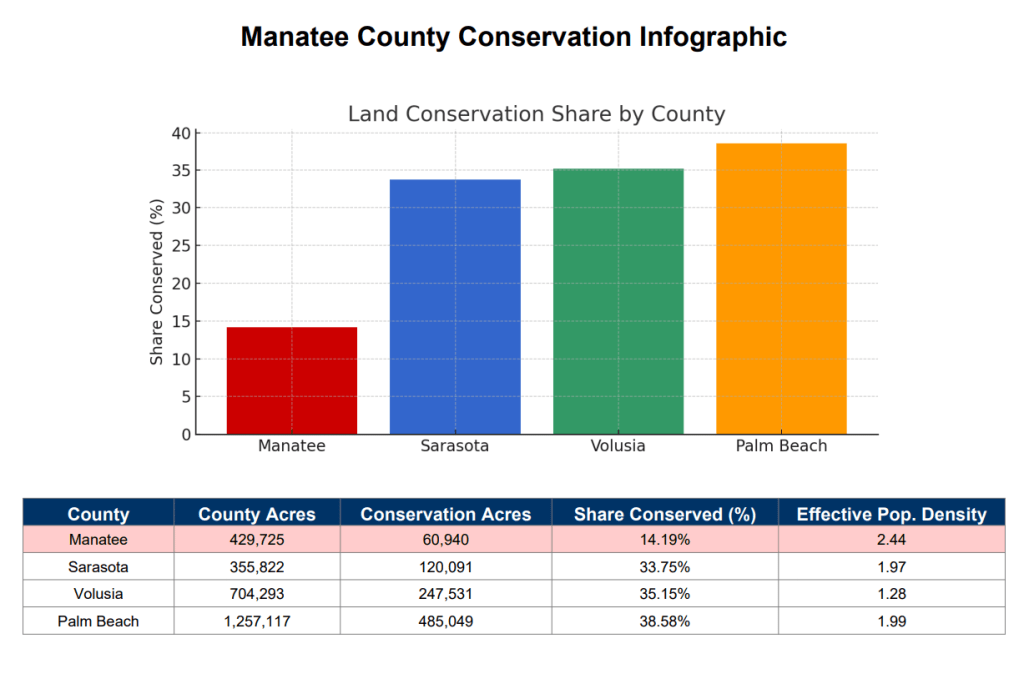
Shockingly, many Florida counties have low percentages of land set aside for conservation, leaving fragile ecosystems, wildlife habitats, and vital water resources at risk. Counties that have taken on the burden of having over 50% of their county in conservation, take a hit on their taxable income. Counties such as Manatee County should have more than 14% of land in conservation. With many rivers, lakes, and even a state park, this number should be MUCH higher. For example, Sarasota County, our neighbor to the south has over twice the amount of acreage in conservation than Manatee does. Granted, they have less acres, but not enough to be double what Manatee’s conservation is. The question to ask is, where does your county stand? What percentage of land is in conservation? Effective Population Density adjusts the density to reflect that not all land is available for development, because some portion is in conservation. What is that number for your county?

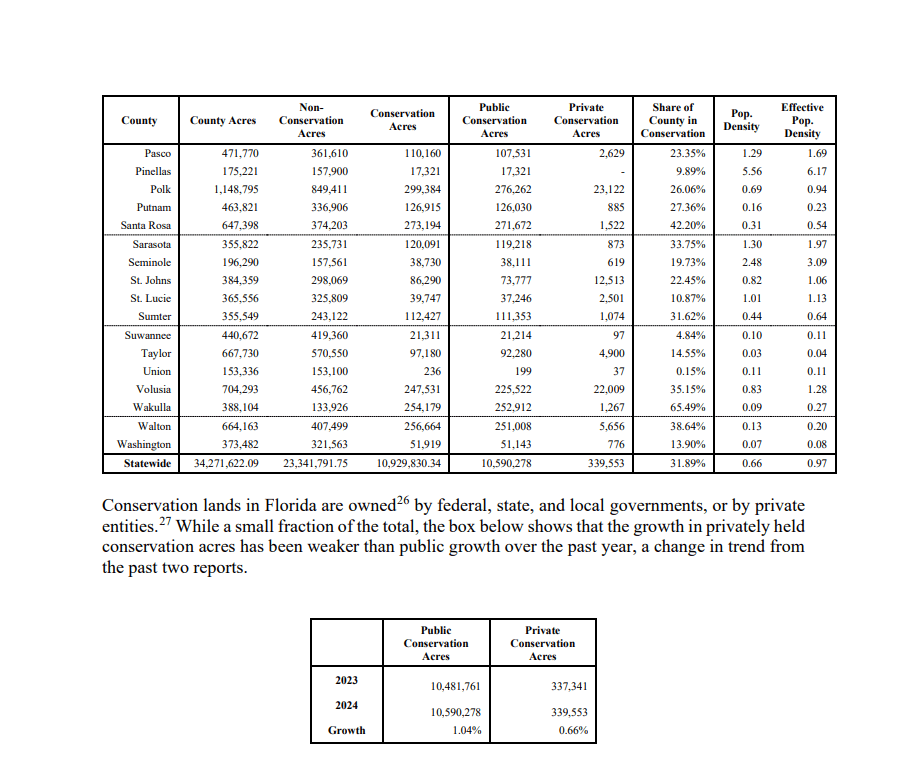
If we want Florida to remain a place of natural beauty, clean water, and thriving biodiversity, we must act now. This means:
- Urging local leaders to expand conservation programs in under-protected counties.
- Supporting ballot initiatives and funding measures that dedicate resources to land acquisition and preservation.
- Getting involved at the community level—from volunteering with conservation groups to advocating for smarter growth policies.
Every acre protected today is an investment in Florida’s future. Together, we can ensure that future generations inherit a state defined not just by rapid growth, but by a strong commitment to protecting the wild places that make Florida unique.
👉 “Pull up a chair on The Veranda View — subscribe today and be part of the conversation on protecting Florida’s natural beauty for generations to come.”
Written by Janyel Taylor & Edited by John Taylor

 The Veranda View